


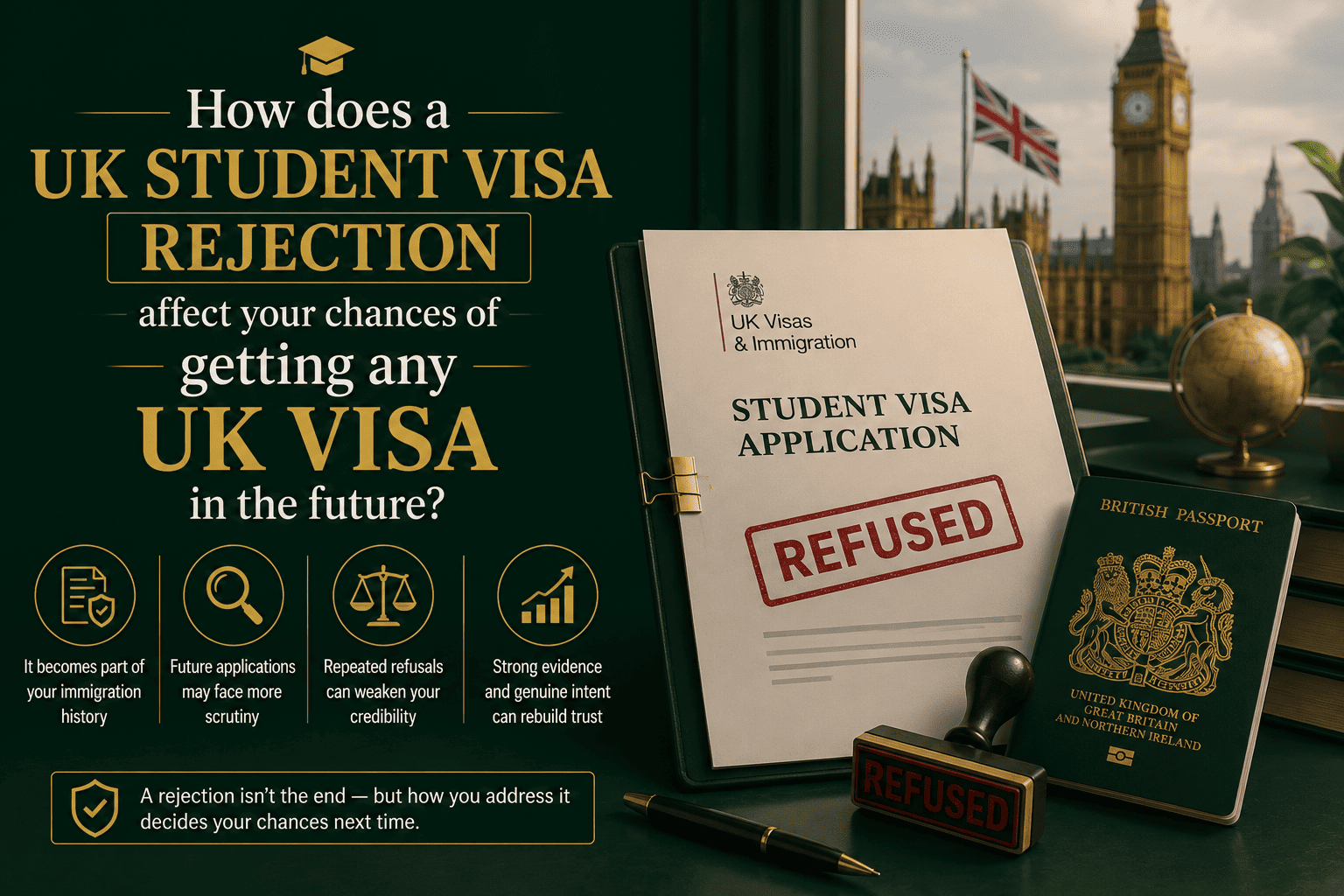
A UK student visa rejection doesn't just cancel your study plans. It follows you. Every UK visa application you make from this point forward will reference it. The caseworker processing your spouse visa, your work visa, your tourist visa, they will all see it. And they will all ask why it happened.
Most UAE students don't realise this until they apply for something else years later and find that old UK student visa rejection sitting on their record asking to be explained.
Here's what it actually does to your future applications and what you can do about it right now.
What a UK student visa rejection actually puts on your immigration record
Every UK visa decision is recorded on your UKVI immigration history. That includes refusals. A UK student visa rejection creates a permanent entry on that record — the date, the route, and the reason codes the Home Office used to refuse it.
It doesn't expire. There's no rehabilitation period after which it stops being relevant. Five years from now, ten years from now, a caseworker processing any UK visa application you submit will see it.
That's the reality most people aren't told when they get the refusal letter.
What top authorised UK-based caseworkers look for when they see a previous rejection
An Entry Clearance Officer reviewing a future application sees two things when a prior UK student visa rejection appears: the reason it was refused and whether the new application addresses that reason directly.
If the original rejection was for insufficient funds and your new application is for a work visa with strong financial evidence, the impact is manageable. If the new application doesn't acknowledge the previous refusal at all, that alone raises a credibility concern. Silence on a known refusal looks like concealment.
It doesn't have to tank your application. But it has to be handled correctly.
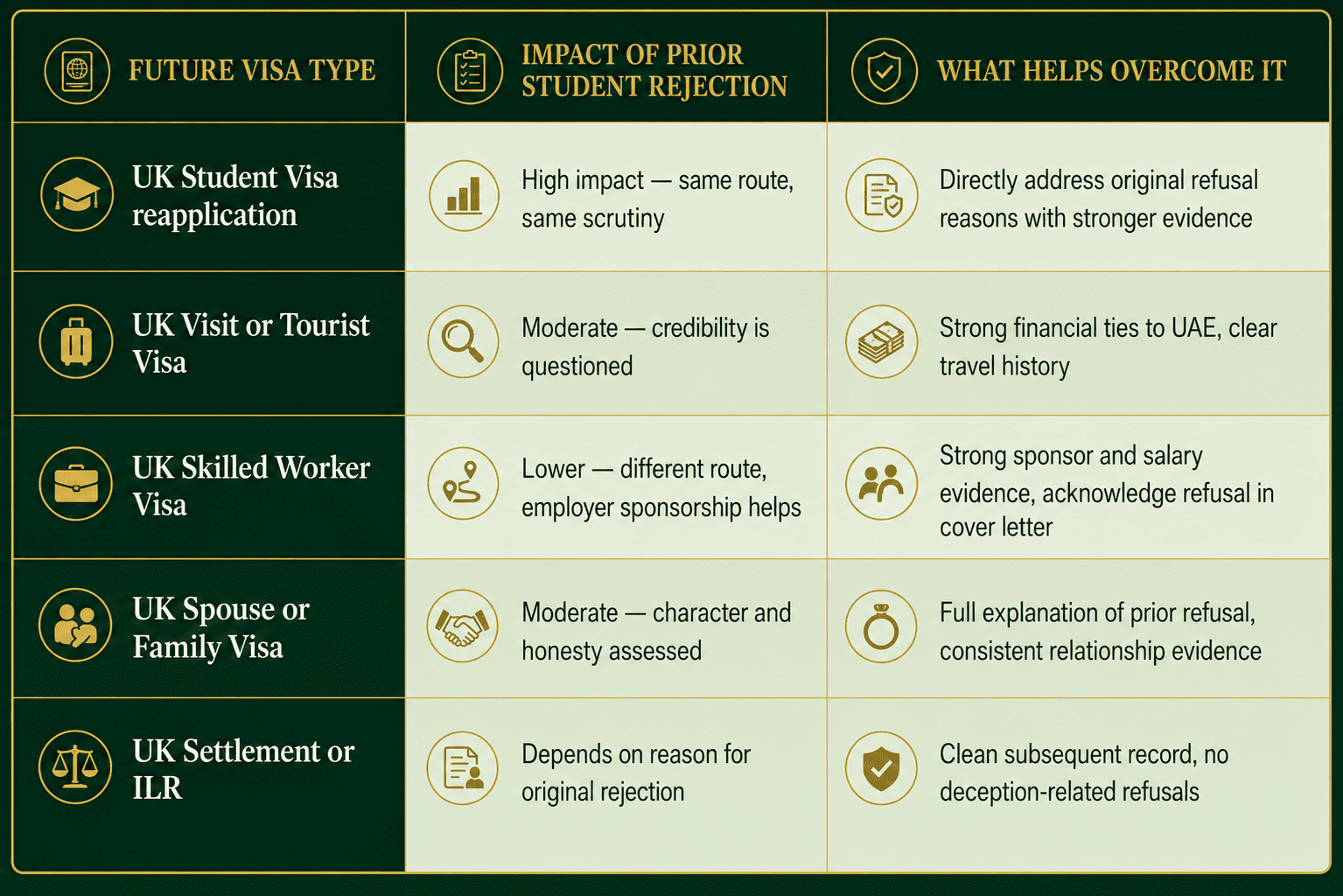
How a UK student visa rejection affects different future visa types
The impact varies depending on which visa you apply for next and how much time has passed. Some routes are more sensitive to prior refusals than others.
The one rejection reason that causes the most damage to future UK visa applications
Not all rejection reasons carry equal weight. A refusal for insufficient funds is serious but fixable. A refusal that includes a finding of deception, false documents, or misrepresentation is a different category entirely.
A deception-related UK student visa rejection can result in a 10-year ban from the UK. And it affects every UK visa application you ever make because the Home Office treats past deception as a direct indicator of future dishonesty. That finding follows you in a way that a straightforward financial refusal simply doesn't.
If your refusal letter mentions deception, misrepresentation, or paragraph V3.6 of the Immigration Rules, get specialist legal advice immediately. That's not the time for a general adviser.
What UAE students must do after a UK student visa rejection to protect future applications
The steps you take immediately after a rejection determine how much damage it does long-term. Most students do the wrong things in the wrong order.
- Read the refusal letter fully and identify every reason code used
- Keep a copy of every document submitted with the original application
- Never omit the previous rejection when declaring immigration history on any future UK application
- Get a UK-licensed immigration specialist to assess the refusal before you reapply for anything
- Address the rejection reasons directly in every subsequent UK application cover letter
- Build a clean subsequent record like strong, approved applications in other visa categories help rebuild credibility over time
Why an exclusive licensed UK office matters more after a rejection than before one
Before a rejection, specialist advice is valuable. After one, it's critical. The way you handle a UK student visa rejection in subsequent applications determines whether it remains a one-time problem or becomes a recurring obstacle.
Miller and Carter Immigration operate from a fully licensed UK office with UK-trained solicitors who handle post-rejection strategy for Dubai-based students and professionals. Top-notch, authorised, and exclusively UK-focused, they assess the original refusal, identify the long-term risk to your immigration record, and build subsequent applications that address the rejection head-on rather than hoping caseworkers overlook it.
A UK student visa rejection on your record doesn't have to define every application that follows. Book your consultation with Miller and Carter today. A licensed UK specialist will assess your rejection, protect your future applications, and give you a clear strategy forward.
millerncarter.ae — UK Student Visa Rejection Support
FAQ
Does a UK student visa rejection need to be declared on future UK visa applications?
Yes. Always. Every UK visa application asks whether you have previously been refused a UK visa. Answering no when a refusal exists is treated as deception, which is a far more serious problem than the original rejection itself. Always declare a prior refusal and address it directly with an explanation in your cover letter or supporting statement.
How long does a UK student visa rejection stay on your record?
Permanently. There is no expiry date on a UK visa refusal record. The UKVI immigration history retains all refusal data indefinitely. What changes over time is how much weight a caseworker gives to an older refusal, particularly if subsequent applications have been approved. A clean record since the rejection helps significantly but doesn't erase it.
Can a UK student visa rejection prevent you from getting a work or spouse visa later?
Not automatically. A UK student visa rejection doesn't bar you from applying for other visa categories. But it does add scrutiny to every future application. Caseworkers look at the reason for the original rejection and assess whether the same concerns apply to the new application. A well-prepared subsequent application that addresses the rejection directly has a strong chance of approval.
What is the difference between a UK student visa rejection and a refusal?
In practice, the terms are interchangeable. Both mean the Home Office declined to grant the visa. The word used in official correspondence is "refused" but many applicants use "rejected" to describe the same outcome. What matters is not the terminology but the reason codes stated in the refusal letter, as these determine the long-term impact on your immigration record.
Conclusion
A UK student visa rejection stays on your record permanently. It doesn't disappear after a year. It doesn't reset when you switch visa categories. Every future UK application references it.
That doesn't make future applications impossible. It makes preparation more important. The students who recover well from a UK student visa rejection are the ones who address it directly, build a clean subsequent record, and never try to hide it.
Get the right advice now, before the rejection causes more damage than it needs to.