


Your university accepted you, but your visa was refused. For many UAE students, the problem is not the whole application. It can be something small, like a mismatched date, a bank balance that changed, or an answer that was not clear enough.
UK student visa refusal happens more often than universities tell you. And the reasons aren't random. Entry Clearance Officers follow a specific checklist when they read your application. Every item on that list either builds confidence or raises a flag.
Here's what they actually look at, and where UAE students keep getting it wrong.
What triggers a UK student visa refusal from the UAE
The Home Office doesn't refuse applications randomly. There are specific, documented reasons that appear on refusal letters again and again. Most of them share one thing in common: the officer couldn't be satisfied on a particular point based on what was submitted.
Satisfaction is the legal standard. Not proof. Not certainty. Satisfaction. And what satisfies one caseworker might not satisfy another, which is exactly why the strength and consistency of your evidence bundle matters so much more than people expect. 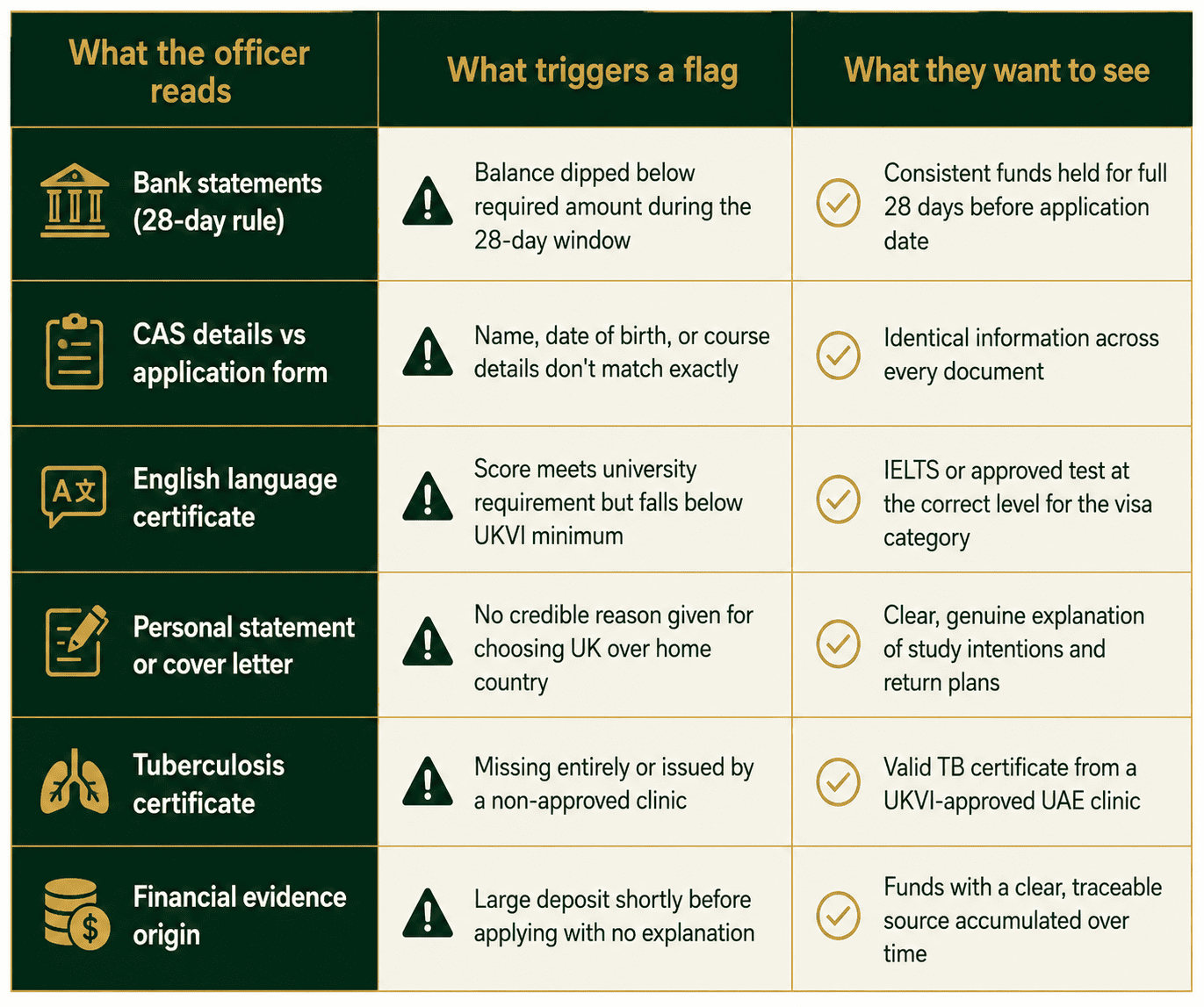
The authorised document the Home Office reads before anything else in your file
It's your CAS. The Confirmation of Acceptance for Studies is the first thing an Entry Clearance Officer checks. Every other document in your bundle is then verified against it.
If your name on the CAS doesn't exactly match your passport, that's a flag. If the course start date on the CAS differs from what appears elsewhere in your application, that's a flag. These aren't major errors to you. To a caseworker processing hundreds of files a week, they're reasons to refuse.
Most UAE students don't check this. They assume the university got it right. Sometimes they didn't.
The financial evidence section is where most UAE student visa refusals actually happen
The 28-day rule is the most misunderstood requirement in UK student visa applications. Your funds must be held continuously for 28 days before the date of your application. Not 28 days before your course starts. Before you apply.
One dip below the required threshold during those 28 days and the requirement is not met. It doesn't matter if you had enough money before or after. The officer looks at the lowest balance within the window. That single figure can be the difference between approval and a UK student visa refusal.
What top-notch licensed UK-based advisers check in financial evidence that most applicants miss
Three things get missed constantly. First, the source of funds. A large transfer into your account with no explanation of where it came from raises immediate concerns about whether the funds are genuinely available to you.
Second, the currency conversion. If your funds are in AED and the requirement is in pounds sterling, the conversion must be calculated at the rate on the date of application, not today's rate.
Third, parental funds. If a parent is funding your studies, their bank statements must demonstrate they have the funds and a letter confirming they're willing to release them to you. Without that letter, the evidence doesn't satisfy the requirement even if the money is there.
What the personal statement tells the Home Office that most UAE students get wrong
The personal statement is not a formality. The Entry Clearance Officer uses it to assess two things: whether your reason for studying in the UK is credible, and whether you intend to return to the UAE afterwards.
Vague statements fail both tests. "I want to further my education" says nothing. It doesn't explain why the UK specifically, why this university, or why this course leads to something meaningful when you return home. An officer reading that statement has no basis to be satisfied.
What works is specificity. Why this course. Why now? What you plan to do with it in the UAE. That narrative, when it's credible and consistent with everything else in the file, is far harder to refuse.
Why an exclusive UK-authorised firm builds your statement differently from a general adviser
A UK-licensed solicitor knows the UKVI guidance that Entry Clearance Officers follow when reading personal statements. They know which phrases flag concern and which ones build credibility. That knowledge comes from working inside the UK immigration system, not around it.
Miller and Carter Immigration operates from a fully licensed UK office, staffed by UK-trained solicitors who handle student visa refusal cases for Dubai applicants. Top-notch, authorised, and exclusively focused on UK immigration — they review every element of your application against current UKVI guidance before a single document is submitted.
Don't let a preventable UK student visa refusal cost you your university place. Book your consultation with Miller and Carter today. A licensed UK specialist will read your full application bundle and fix what's flagging before you submit.
millerncarter.ae — UK Student Visa Refusal Support
FAQs
Why does the Home Office refuse a UK student visa even when the university accepted me?
University acceptance and visa approval are completely separate decisions made by different bodies. The university assesses your academic suitability. The Home Office assesses your financial evidence, immigration history, and whether you meet the specific requirements under the Immigration Rules. Meeting one doesn't guarantee the other.
What is the 28-day rule for UK student visa financial evidence?
Your required funds must be held in your account continuously for 28 days before the date of your visa application. If your balance drops below the required amount even once during that window, the financial requirement is not met and the application will be refused. The officer checks the lowest balance within the period, not the average.
Can a UK student visa refusal be fixed with a stronger reapplication?
Yes, in most cases. A fresh application that directly addresses the specific refusal reasons with stronger, more consistent evidence has a good chance of approval. The critical rule is that the new application must fix what went wrong, not simply resubmit the same documents. Ignoring the previous refusal reasons in a new application almost always produces the same result.
Does a UK student visa refusal affect other UK visa applications in the future?
Yes. All UK visa refusals are recorded on your immigration history and referenced in future applications. It doesn't permanently bar you, but it requires explanation every time you apply. A strong subsequent application that addresses the refusal directly can overcome the record. Attempting to minimise or omit it is treated very seriously by the Home Office.
Conclusion
UK student visa refusal almost never happens because someone was ineligible. It happens because something in the file didn't satisfy the Entry Clearance Officer, a number that didn't add up, a statement that wasn't credible, a document that was missing.
The Home Office reads your application in a specific order with specific questions in mind. Understanding those questions before you submit is the only way to make sure your answers are already there.
Get your file reviewed by a UK-licensed specialist before it goes anywhere near a submission portal. That single step prevents most UK student visa refusals before they happen.